
Course:
Communication For Success

Outcome: Associates learn how to truly understand each other and our customers—so they can complete the job accurately, diagnose correctly, and document the interaction so success is just part of the day.
|
1 |
What Active Listening Really Is |
|
2 |
Why Most People Get It Wrong |
|
3 |
The Core Shift: Listen to Understand |
|
4 |
Tactical Tools (Verification + Questions) |
|
5 |
Interactive Simulation |
 |
Most people think listening is automatic. It’s not. |
Active listening is a deliberate skill.
This means:
Fully focusing on the person speaking
Understanding what they’re saying
Understanding what they mean
And confirming it before moving forward
It is not:
Active listening is making sure you actually understand the problem, and this means listening carefully, asking strong, open-ended questions, and repeating the answers until you have clarity.
Just keep in mind, how likely are you going to be able to find the right solution or complete the job accurately if you don’t know what the problem is, or what is involved in the job?
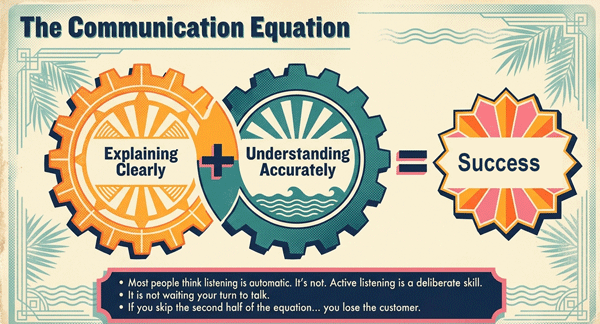
Communication has two halves:
Explaining clearly
Understanding accurately
If you skip the second half… You lose! You might just as well have talked to yourself.
Here’s the problem…
Most people don’t listen to understand.
They listen to:
Respond
Fix quickly
Or find a way to respond that makes the original speaker happy..
Bad listening leads to:
Wrong solutions
Wasted money
Lost trust
The Mindset Change
Old Way:
“I need to fix this fast.”
✅ New Way:
“I need to understand, and to do this I need to listen carefully and ask clarifying questions.” Always remember the goal is not to get to a solution quickly but to get to the right solution or to thoroughly understand what is being said or asked before taking action.
Great communicators slow down.
They ask:
What’s really going on?
What caused this?
What’s the problem?
Because:
The first answer you may come up with is rarely the real problem.
Again, remember this if you do not understand the problem or the job: your chances of actually creating the right solution or completing the job correctly are next to zero.

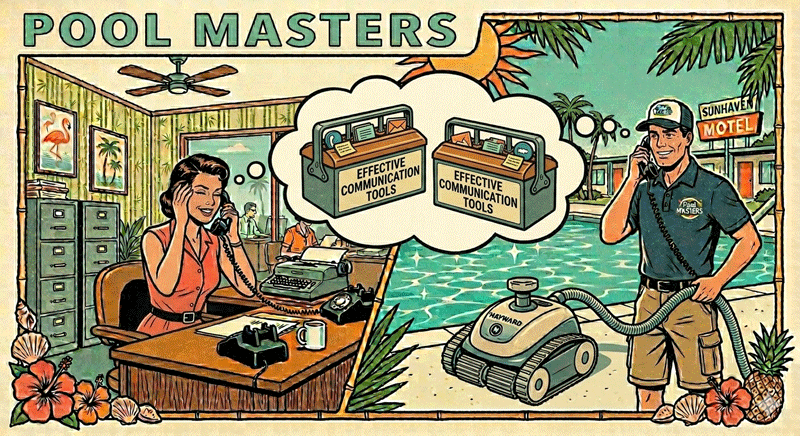
The manager says, “I need you to take the auto cleaner out to customer x”
Tech says “Ok” while thinking about what he is going to get for breakfast.
Result: tech drops off cleaner.
The customer calls back in and complains that the cleaner was not hooked up. Now the office is calling the tech and asking them to go back and hook up the cleaner.
This is a huge waste of time and money. More mony on gas, time that the tech could have used to complete other pools. Plus, the customer is unhappy because they have had to call back and remind us to do what should have been done in the first place.
The tech is unhappy because no one told him to hook it up, and now he has to take time to go back. The office is unhappy because they had to listen to a customer complaint, and stop what they were doing to call the tech. The customer is unhappy because we did not do what we said we would.
Here is the question: whose fault is this?
The answer is: both. Verbal communication broke down with the instructions, and the clarifying questions did not happen.
This situation or something like it happens every day multiple times, but with just a few extra moments, the whole situation could have been easily avoided with one simple question and caring enough to listen. By just asking, “Do I need to hook it up?” The time wasted is recovered, and everyone is happy.
Remember, asking that clarifying question to make sure the other person understands, shows that you care enough to get the job done right the first time.
Repeat back what you heard.
“What I’m hearing is…”
Customer:
“My pump is making a weird noise, and pressure dropped.”
You:
“What I’m hearing is the pump started making noise, and now your pressure is lower than normal—did I get that right?”
Now the customer feels:
Heard
Understood
Confident in you
“Tell me what you’ve noticed over the last few days.”
“When did this start happening?”
“What changed recently?”
These unlock real information.
“Did you shock it?”
“Is the filter dirty?”
These types of questions are yes or no. They do not unlock new information.
Listening is not automatic—it’s a skill
Don’t jump to solutions
Use the Verification Loop
Ask open-ended questions
Understand first, then solve


