Pool Masters Commercial Technician Training

- Description
- Reviews
- Grade
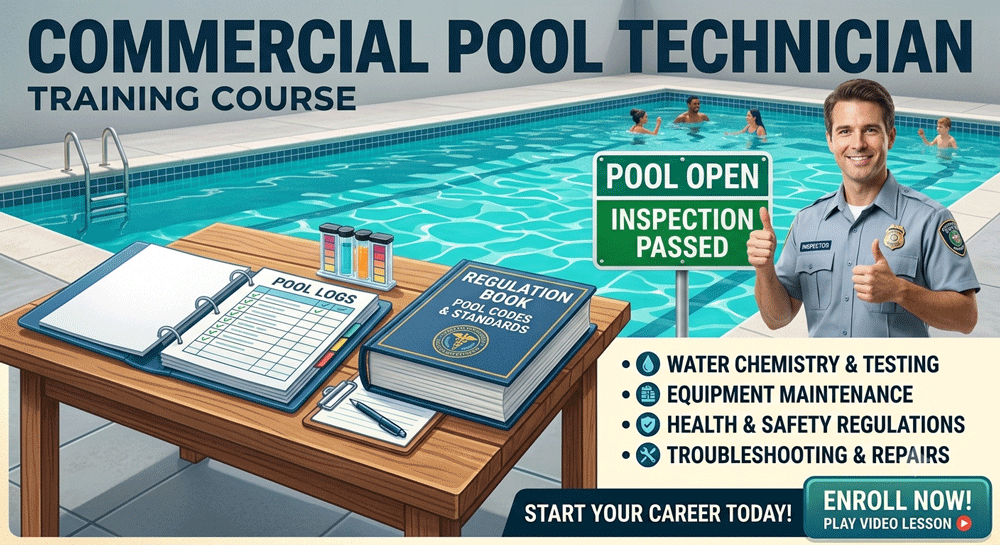
This course covers all of the areas a commercial pool maintenance technician should know to effectively service commercial pools.
It is broken down into a series of modules that cover the following areas:
- Culture Communication
- Regulations
- Standard procedures
- Chemistry
- Equipment
- Filtration
To access the course material:
Look at the top of the page you will see three headers: Description, Curriculum, Reviews.
To access the modules, select Curriculum; then you will see the modules and lessons in each module. Complete the lessons in order to complete the module.
Enrolled in the Pool Masters Commercial Training Program
Commercial Pool Technicians

-
1
 What is culture
Learn what the Pool Masters culture is and why it matters
-
2
Communication Standard
Why is good communication critical to achieving our goals
-
3
 Property Communication
Required communication from the technician to the property
-
4
Office Communication Protocol
Office requirements to maintain superior communication with customers and the team
-
5
 Module 1 QuizThis quiz covers all of Module 1
-
6
Commercial Pool Maintenance Standards
Learn how to deliver commercial pool maintenance with professionalism, consistency, and attention to detail—from arriving on schedule and communicating with property staff to inspecting equipment, servicing the pool, documenting chemical readings, and securing the site. Students will master the Commercial Maintenance Technician Protocol and learn to create thorough weekly reports with maintenance details, equipment conditions, repair recommendations, and photos.
-
7
Operation Log
Review of the required DH921 log
-
8
Module 2 QuizModule 2 Questions
-
9
Florida Public Pool Safety and Operations
Learn how Florida’s DBPR and Department of Health divide pool oversight, and identify how requirements vary among conventional pools, spas, and wading pools. You’ll master the seven critical closure conditions—including water chemistry, visibility, suction hazards, barriers, temperature, and safety equipment—and learn how to complete the DH 921 log with required manual test records.
-
10
Module 3 Regulations QuizQuestions cover Module 3
-
11
Understanding Acids and Bases
-
12
Why Buffers Matter
Why Buffers Matter
Imagine driving a car without shock absorbers. Every bump, pothole, and crack in the road would send the vehicle bouncing out of control. Total alkalinity works the same way in your pool. It acts as the water's chemical shock absorber, preventing sudden changes in pH whenever acid, rain, swimmers, or other contaminants are introduced. Without this buffer, your pool chemistry becomes unpredictable, chlorine becomes less effective, and both your pool surfaces and equipment begin to suffer. Understanding how buffering works—and recognizing the signs of low alkalinity—is one of the most important skills for maintaining stable, healthy, and trouble-free pool water.
-
13
Chlorine the sanitizer
Chlorine is the most important chemical used in swimming pool maintenance. Every day it destroys harmful bacteria, viruses, algae, and other contaminants that enter the water. But chlorine does much more than simply "kill germs." Most of its work is actually spent oxidizing non-living contaminants such as sweat, body oils, sunscreen, cosmetics, and other organic waste.
Understanding how chlorine behaves in water—and the factors that affect its performance—is essential for every pool technician. A technician who understands chlorine chemistry can diagnose problems quickly, reduce chemical costs, improve water quality, and keep pools safe for swimmers.
This lesson explains not only how chlorine works, but also why it sometimes doesn't, and what you can do about it.
-
14
Your Chlorine Protector
Why Cyanuric Acid Matters
Chlorine is your pool's primary sanitizer, but without protection, it doesn't last long in the sun. On a bright day, ultraviolet (UV) rays can destroy most of your free chlorine in just a few hours, leaving the pool vulnerable to algae and bacteria. Cyanuric Acid (CYA) acts as a chlorine stabilizer, protecting it from sunlight and allowing it to sanitize the pool longer and more efficiently. Like all pool chemicals, however, balance is essential. Too little CYA wastes chlorine, while too much can reduce chlorine's effectiveness. Understanding how to properly manage CYA is a key step in maintaining clear, safe, and economical pool water.
-
15
Phosphate Food For Algae
Phosphates and Algae: Why They Matter
Phosphates are one of the most common nutrients found in pool water. While they don't directly affect swimmer safety, they are the primary food source for algae. Think of phosphates as fertilizer for your pool—the more phosphates present, the easier it is for algae to grow. Chlorine can still kill algae, but high phosphate levels force it to work much harder, increasing chemical use, maintenance, and operating costs.
-
16
Calcium Hardness: Protecting The Pool
Calcium hardness is one of the most important factors in maintaining balanced pool water. It measures the amount of dissolved calcium in the water and plays a critical role in protecting pool surfaces and equipment. Too little calcium makes the water aggressive and corrosive, while too much leads to scale buildup and cloudy water. The goal is to maintain the right balance, especially in Florida, where high temperatures and evaporation constantly affect water chemistry.
-
17
Enzymes: Helping Chlorine Work Smarter
Chlorine is the primary sanitizer in every swimming pool, but much of its job isn't killing bacteria—it's oxidizing non-living contaminants such as body oils, sunscreen, sweat, cosmetics, and other organic waste. The more organic material in the water, the harder chlorine has to work. Enzymes help by breaking down these contaminants before chlorine has to oxidize them. This allows chlorine to focus on what it does best: keeping the pool safe and sanitized.
-
18
Module 4 Chemistry QuizCovers Module 4 Chemistry
-
19
Calculating Pool Volume:
In this lesson, students will learn to calculate pool volume in gallons using average depth, the 7.48 gallons-per-cubic-foot conversion, and clear formulas for square/rectangular and circular pools. They will also learn how to estimate the volume of a kidney-shaped pool by dividing it into simpler sections, work through practical examples, and round results for easy field dosing.
-
20
Chlorine Dosing Made Simple: Formulas, Field Shortcuts, and Florida Safety Rules
Learn to dose chlorine confidently by using the “1/100,000 Rule,” the 12.5% field shortcut, and a practical formula to calculate the correct amount for any pool size and desired ppm increase. Through real-world examples and practice questions, you’ll also learn Florida’s safe free-chlorine ranges—1.0–10.0 ppm for public pools and 2.0–10.0 ppm for spas—and the required one-hour wait after manual chemical additions.
-
21
Dosing Alkalinity in Commercial Pools: Formula, Examples, Best Practices, and True TA Correction
Learn how to calculate and safely dose sodium bicarbonate to raise Total Alkalinity (TA) in commercial pools, using the formula **Lbs Needed = (Desired Increase ÷ 10) × (Pool Volume ÷ 10,000) × 1.5** and practical examples. Students will learn to target Florida’s recommended **80–120 ppm** range, correct tested TA for CYA using **True TA = Tested TA − (⅓ × CYA)**, and apply best practices for adding alkalinity evenly and effectively.
-
22
Muriatic Acid : Safe Dosing, Formulas, and Best Practices
Learn how to test and lower high pool pH safely using muriatic acid, including the 10,000-gallon dosing formulas, target pH range, and scaling examples for different pool sizes. Students will also practice essential best practices—wearing protective gear, diluting acid correctly, running the pump, adding acid safely, and observing the required one-hour swimmer-closure period.
-
23
Dosing Cyanuric Acid (The Sunscreen / CYA)
In this lesson, students will learn how cyanuric acid (CYA) protects chlorine from sunlight, calculate dosing needs using the formula **13 oz by weight per 10,000 gallons raises CYA by 10 ppm**, and work through practical examples. They’ll also explore Florida target levels, the risks of excessive CYA and “chlorine lock,” the sock-method application technique, and commercial-pool best practices—including where CYA is prohibited.
-
24
Pool Calcium Dosing Made Easy: The Formula, Examples, and Safe Best Practices
Learn how to calculate and safely dose calcium chloride to raise pool calcium hardness using the formula: **Lbs Needed = (Calcium Gap ÷ 10) × (Pool Volume ÷ 10,000) × 1.25**, with practical examples for real-world pool sizes. Students will also master safe “hot bucket” pre-dissolving techniques, protective practices, and the dilution method for reducing calcium levels that are too high.
-
25
The Water Detective: Troubleshooting Pool Water Problems
In this 5-minute lesson, become a “Water Detective” by learning to identify the causes behind common pool water colors, from algae and metals to scale and storm-related contamination. You’ll also distinguish oily scum from hidden biofilm and apply the correct troubleshooting order—using testing, brushing, cleaning, and targeted chemicals—to solve problems effectively without creating new ones.
-
26
Mod5 Dosing QuizThis quiz covers Module 5 dosing
-
27
Commercial Pumps: Power, Components, and Safety Essentials
In this five-minute lesson, learners will explore how commercial pumps differ from residential systems, including three-phase power, motor rotation, voltage requirements, and the absence of start capacitors. They’ll also identify separate strainer pots, flange gaskets, and common pump materials while learning essential safety and inspection practices for commercial pump rooms.
-
28
ORP in 5 Minutes: Understanding, Measuring, and Maintaining Sanitizer Effectiveness
In this 5-minute lesson, you’ll learn what ORP is, how it measures sanitizer effectiveness in real time, and why it matters for safe, properly maintained water. You’ll explore the relationship between ORP, chlorine, pH, and stabilizer levels, compare platinum and gold probes, and gain practical skills for measuring and maintaining accurate readings in the field.
-
29
ORP How they work and best practices
Detailed instructional video from the manufacture on how to properly maintain and work with ORPs in commercial pools
-
30
Module 6 Pumps ORP Valves QuizThis quiz covers Module 6
-
31
How Commercial DE Filter Pits Work
In this five-minute lesson, students will learn how commercial DE filter pits use microscopic filtration to remove particles as small as 1–3 microns and produce exceptionally clear pool water. They’ll also explore the hydraulic loop, including gravity-fed water flow, DE “cake” formation, vacuum filtration, and how open pits provide surge capacity when pools experience sudden increases in water volume.
-
32
Commercial Filtration Pit Cleaning: A Safe, Step-by-Step Checklist
In this lesson, students will learn how to safely clean a commercial vacuum filtration pit using a step-by-step checklist, including lockout/tagout, pit isolation, draining, grid washdown, slurry evacuation, and inspection. They will also learn proper refill and DE pre-coating procedures—including the 2-ounce-per-square-foot rule—to protect filter grids, prevent cloudy water, and comply with waste-disposal requirements.
-
33
Vac Pak Cleaning Instructions
Manufacture discussion on the parts of a DE filter pit and how to clean it.
-
34
The Float Valve
This lesson covers the float valve. Why it is so important, how it works and how to adjust it.
-
35
Pool Systems Check: Flow, Temperature, Level, and Valve Controls
In this 5-minute lesson, commercial pool operators, service technicians, and facility managers will learn how to verify flow, temperature, water levels, and valve operation to support safe, efficient, and inspection-ready pool systems. They’ll connect equipment readings and physical symptoms to Florida DOH Chapter 64E-9 requirements, identify common violations and operational consequences, and apply quick troubleshooting and corrective actions in the field.
-
36
DE Separation Tanks: Protecting Pools, Pipes, and Public Health
In this lesson, learners will discover how DE separation tanks capture diatomaceous earth and debris during commercial pool backwashing, protecting pipes, sewer systems, storm drains, and public health. They will also learn about proper waste disposal, DOH requirements for public pools, and the serious compliance risks associated with faulty or leaking tanks.
-
37
Module 7 DE Pitts QuizThis quiz covers module 7 DE Filter Pitts
-
38
Inside a Commercial Sand Filter: How High-Capacity Filtration Works
In this 5-minute lesson, students will explore how commercial sand filters handle high flow rates, heavy bather loads, and rapid water turnover through deep media beds, durable pressure vessels, advanced underdrains, and automated valve systems. They will compare commercial and residential filters and learn how air scour and hydraulic backwashing restore filtration performance.
-
39
Commercial Sand Filter Cleaning & Maintenance Essentials
Learn how to monitor differential pressure and safely perform air scour, high-rate backwash, rinse, and return-to-filter cycles to keep commercial sand filters operating efficiently. You’ll also explore long-term maintenance practices—including chemical degreasing, acid washing, internal inspections, media top-offs, and proper lockout/tagout procedures—to prevent buildup, protect equipment, and maintain water quality.
-
40
Module 8 Sand Filter QuizThis quiz covers module 8 sand filters